

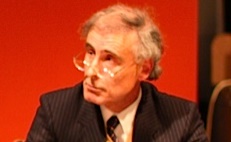
‘Single Spies’, the Civic Players’ production of Alan Bennett’s espionage duet, is well-timed. Whilst old school spying – dead letter boxes, shadowy contacts and Cold War politics – may now be the subject of movies rather than the media, the gathering of nations’ secrets and the exposure of the gatherers are making headlines. And the gatherers are in exile: Edward Snowdon is the ‘guest’ of Putin’s Russia and Julian Assange is languishing in the Ecuadorian Embassy in London. Meanwhile, a new phase of the East/West political chess game is being played in the Ukraine.
Bennett’s subjects are two of the ‘infamous’ Cambridge spies who were recruited by Soviet Intelligence in the 1930’s and passed secrets to the KGB until exposed in the 1950s. Guy Burgess and Anthony Blunt were both members of the British establishment, both upper-class and privileged. The plays do not address – other than obliquely – the ideology that persuaded them to become traitors but focus on them as men, living with the consequences of their actions in the only way they can.

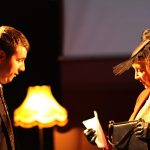



In ‘An Englishman Abroad’, Burgess is living in a seedy Moscow apartment, cut off almost entirely from his former English comforts – family, friends, good tailoring, soap, entertainment – and gossip. Ironically, he is allowed the company of a young man, Tolya, his homosexuality no longer something which must be hidden. As Burgess, Paul Smith is appropriately flamboyant, allowing the audience to be drawn to him for his sardonic humour, stoical resilience and wry disdain for “the comrades” who continue to monitor his every action. We are allowed to glimpse in moments of reverie his underlying resentment and hints of bleakness – making the bluster appear as if he is valiantly bluffing.
This is an expansive and sympathetic performance, convincing in its apparent unrepentance and charm and moving in its portrayal of Burgess’s sentimental attachment to Englishness. The performance makes much of the character’s disarming openness and lack of guile so that in the final scene, with Burgess once more clothed as ‘an upper-class Englishman’ – and jaunty as a result – we respond with sympathy and not a little admiration. His banishment has served the establishment’s need for visible retribution whilst others, no less guilty, have been protected.
Monica Spalding, one of Civic Players’ enviable rank of accomplished performers, plays Coral Browne, in the 1950s the grande dame of British theatre. She is in Moscow performing with the Stratford Memorial Theatre’s production of ‘Hamlet’ and, after an admirably opportunist meeting engineered by Burgess, is persuaded to measure him for new clothes – as actually happened in 1959. In their duologue she matches Burgess for sharp wit and theatrically regal poise, unfazed by the flat’s squalor and being given garlic cloves and a tomato for lunch. She gives the impression of being curious about Burgess and, as an Australian, uncritical. Back in London, her dealings with the shop assistant who refuses to sell Browne pyjamas for “a traitor” because “we supply the Royal Family” allow her to launch a convincingly forthright attack on the stuffy narrow-mindedness and hypocrisy that she is free to despise.
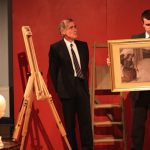
‘A Question of Attribution’ is a more complex piece, pointedly in contrast to the first play. It is ‘the late 60’s’; Blunt, Surveyor of the Queen’s Pictures and Director of the Courtauld Institute, is already known to MI5 as a spy but protected from exposure in return for information. Set in the Courtauld Institute and in Buckingham Palace (both of which have to be recreated in Eight Acre Lane), the locations are deliberately remote from Burgess’s squalid flat.
In the demanding role of Blunt, Richard Prothero has to present two subtly different modes: starchy sufferance when being probed for information by MI5’s Chubb and mastery of ambiguity in his dialogue with the Queen where, beneath apparently benign discussion of authenticity in works of art, there is a subtle subtext framed around the notions of knowledge and deception.
In both modes the actor is the opposite of Burgess. As the script states, he is “an enigma”, and “a cold fish”. His aloofness and caustic sarcasm in his scenes with Chubb are evident, as is his veiled sense of martyrdom. There are moments of delight such as when he acknowledges Chubb’s newly acquired artistic insight with “I can see you’ve been down at Purley Public Library again”. The key mood we sense is prickly tolerance – he has been discovered and must suffer the consequences, however tedious they are. It is interesting to watch how the actor communicates a sense of animation only when talking about art; at other times he remains dryly detached.
In his scene with the Queen he is less prickly but hints at watchfulness. This is a delightful episode in which discussion of forgery, revelation and discovery in works of art have elegant double meanings. His lack of deference and the way he exposes the layers of meaning in the Queen’s paintings is suitably scholarly, but perhaps the strongest element of this performance is its perfect sense of detachment. In revealing details in works of art, he reveals none about himself.
Mary Lewis brings her versatility as an actor to the role of the Queen. She adopts a regal manner – handbag at elbow and hands neatly clasped. Her diction is neat and crisp and she conveys her complete lack of irony whilst revealing more about herself and her response to her role than Blunt does about his. Bennett’s dialogue in this episode is a delight and the actor makes very good use of it.
Jack Glanville as Chubb presents us with the role’s earnest artlessness. In questioning Blunt about his contacts he is less like an inquisitor than a schoolboy out with a butterfly net. But Bennett’s Chubb is far more astute than he seems. And he knows more too. He is ‘seemingly vague, seemingly amiable’. The actor attempts to respond to this stage direction by shedding his affable adolescent manner and adopting a more serious pose in the final scene but it is not entirely coherent.
The plays’ directors have chosen to stage ‘Single Spies’ with their audience on three sides. “This is a first for us,” explained Paul Smith. “We felt that the plays needed this kind of intimacy.” But staging in this way places different demands on the performers than proscenium stages and they need to be sensitive to the audience’s different viewpoints.
After the sell-out success of last year’s production of ‘Calendar Girls’, Civic Players have made an admirable, if challenging, choice in staging Bennett’s two (very different) plays. Whilst there are moments when pace falters and the clarity of Bennett’s brilliant scripts is not quite sharp enough, directors Colin Marshall and Paul Smith and the entire team should be commended for delivering an evening of genuinely entertaining drama – at the right time too.