

Wellington and District u3a held their monthly meeting at the Rugby Club on Monday, writes Anne Dearness.
There was a large and enthusiastic audience, with a new member and several visitors joining us, while regular members eagerly awaited the presentation of The Wonderful World of Glass, given by Francis Burroughs.
He began by introducing glass as a material which occurred naturally some 7,000 years ago, in the form of obsidian, which is so beautiful that it was used ornamentally as beads to be worn and bartered. His example of a necklace had a white flaw in the black glass, which the artist who made it had used to enhance the piece. All this around 100 BC.
From there, we moved to the making of glass as we know it, some 3,000 to 3,500 years ago, in the Middle East and Syria in particular. Glass has been found all over the world, dating from various periods and civilisations, including the Syrians, Egyptians and Romans, to name a few.
Around 100BC, someone realised that you could blow air into a bubble of glass, and so began another venture in a different direction, making vessels that were no longer produced in a mould but could be shaped as required, if you were clever enough.
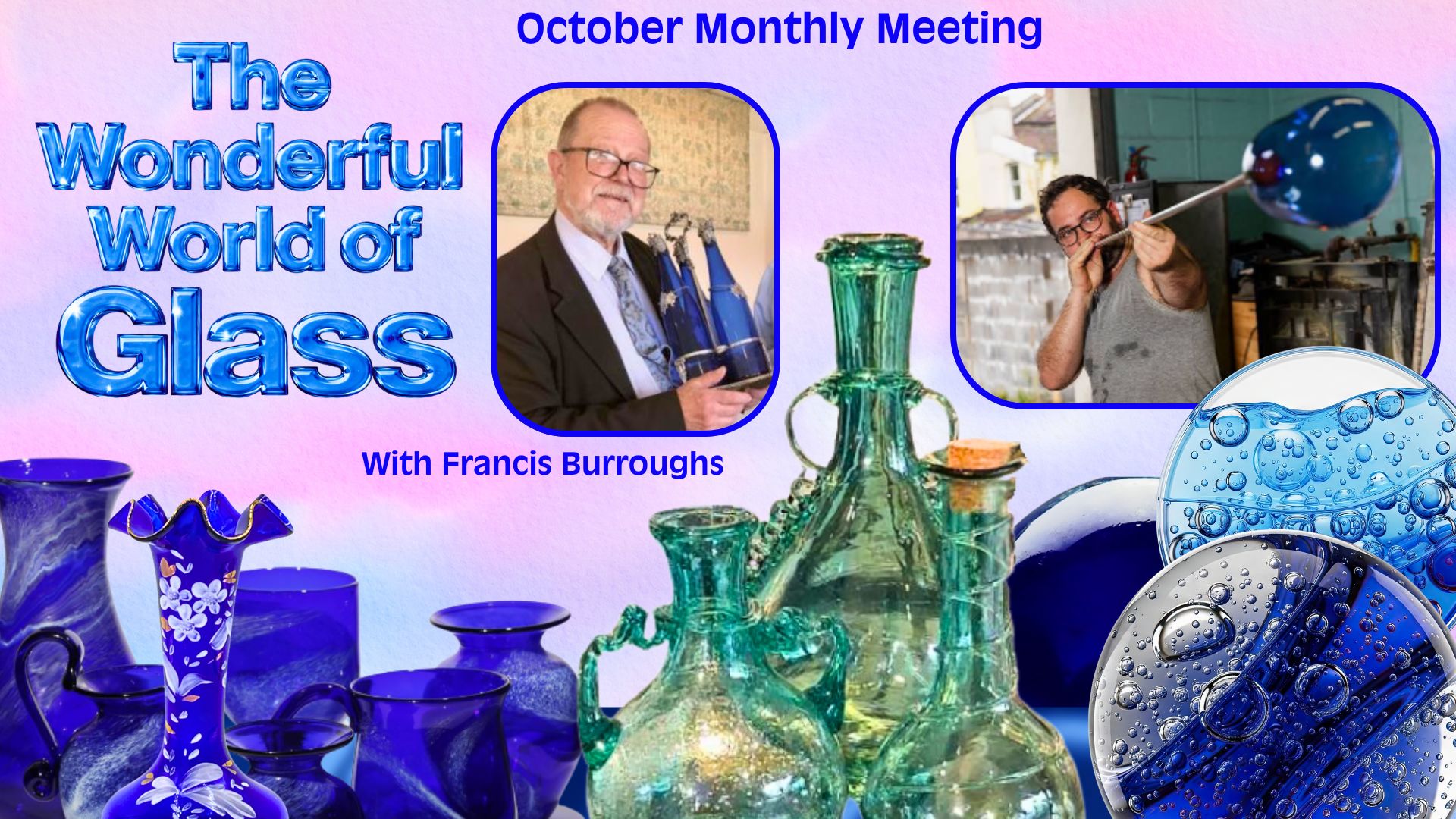
Mr Burroughs brought along a huge quantity of examples to illustrate his talk. These included a picture of an early vase of blue, white and yellow glass, blown in the 14th century; a broken Roman bottle; and also (my favourite) a small, intact bottle from the first century, which looked like a sample bottle from today’s perfume makers.
He went on to explain how glass required exceptionally high temperatures to make it flow, and how artisans needed time and considerable skill to achieve the many examples which not only he displayed, but which are all around us on a daily basis and which we probably don’t even notice, from the bus window we look out of to ornate light fittings.
You cannot talk about glass without mentioning Venice and the island of Murano, known for centuries as an epicentre of glassmaking and innovation. Many examples of the styles and colours used on this island are still around us and in use today.
In 1685, Ravenscroft glass appeared, producing very fine glass, of which, it seems, only around 30 unique pieces still survive, all in museums around the world.
The 18th century brought us blue glass, as cobalt was added to the mix, made world-famous by the Bristol Blue manufacturers.
Then on to Lazarus Jacobs, who was proficient enough to sign pieces dating from 1760, and later his son, Isaac Jacobs, who, in 1805, bought eight blue glass stands for holding decanters, only to discover they were destined for royalty. His letterheads then displayed ‘Purveyors to Royalty’, or words to that effect.
A wealth of facts was presented in an illuminating and entertaining style, along with the artefacts brought to illustrate the theme.
Among those already brought to our attention was glass of Roman origin, some of it in need of repair. There were also some very beautiful examples, including an Irish hobnail goblet and a gorgeous tantalus containing three Bristol Blue decanters with silver collars.
Along with these rather exotic finds was a bowl made using the Graal technique, which I had never seen before. It brought to mind something I can only describe as similar in appearance to cameo glass, although the picture or pattern we see seems to be created by the glass artist without the need for carving, somehow achieved through the removal of wax. I hope I’ve got that right. Forgive me, Mr Burroughs, if I’ve misled anyone!
And finally, the piece that most fascinated me was a standard flask (if anything of this age can be called ‘standard’) which, at some point in its life, had the misfortune to have its neck broken. Someone deemed it so precious that the broken neck was ground down until level and a silver collar was applied.
The reception to this presentation was very enthusiastic, with lots of stories, questions and answers, and applause which continued for some time. The hall was buzzing.
The items on display, including the tantalus, beads of obsidian and various bottles from different centuries, had been passed around the hall as the talk progressed. They had now accumulated on a table at the rear of the hall, where members were enthralled by them before Francis Burroughs collected them on his way home.
The meeting was complete by noon, but it took a while for everyone to leave, as people were reluctant to bring such a very enjoyable morning to an end.